| Mounts |
.
|
| . | Objects on display are mounted for three reasons;
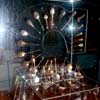
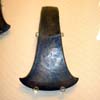
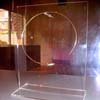
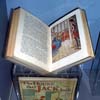
1.All objects will have a gravity determined orientation when placed on to a flat surface. For many objects this orientation may be suitable, for many more this orientation can be improved to display the object to better effect, i.e. to offer an improved view of a relevant feature, to approximate the objects more familiar orientation if this is different from its gravity determined orientation, e.g. a mounted fish specimen might look odd lying on its side. 2.Any object must be well supported to ensure it will not break, fall or distort whilst on display. It may also need to hold the object in place to prevent it leaving the mount through movement or vibration. The materials the mount is made from need to be chosen to accommodate the additional forces of object and mount for the duration of the display and any additional forces e.g. held in place to stop it being moved if on open display. 3.Individual bones, pottery or paper fragments may benefit from a mount that reconstructs them into an approximation of the reassembled whole. |
. |
| Mounts | . |