| Mount design |
.
|
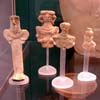
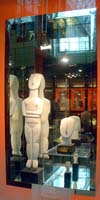
| . | Mounts are used to display objects and should not distract from the objects themselves. They must be made from appropriate materials, provide necessary support, be well designed and be well finished.
The choice of material must be appropriate to the object and display but must also satisfy conservation requirements to protect the object from the addition of the mount. Mounts must not place objects under physical or chemical stress. Choose materials that are chemically inert for the objects displayed, then their strength and workability into the shapes required and only then their appearance. Assess each item and case as required, do not base the choice of material solely on its prior use or the fabrication skills available. Mounts need to be well designed so as not to distract from the objects themselves. This can be achieved by making them as unobtrusive as possible themselves, minimal, neutral and discrete, e.g. it is usually possible to view the metal structure holding a dinosaur reconstruction together, but if this structure was made of wood it would be much more visible. In most instances mounts will remain visible to a certain degree. There will be also be instances were the mount cannot be hidden but will be as apparent as the object itself. It then becomes necessary to design the mount to be displayed together with the object, to create a structure that is unified with the object. This requires a balance in visual weight, colour, texture and size. e.g. coins pinned to a board would look inelegant if large nails were used. Attention to finish detail greatly improves appearance of the combined object and mount. A well made perspex mount can be easily spoilt with glue marks, cracks at screw fixing holes or even fingerprints. It must be possible to be able to remove the object from the mount. All fixings should be de-mountable and accessible. Dismantalible mechanical fixings are much more desirable than adhesives. If adhesives are permitted however they must be reversible with a substance that will not harm the object to allow removal with out damage, e.g. Lepages water soluble gum glue. Cushioning and/or buffering may be required to protect object from the mount or its surface finish when assembled e.g. foam padding applied to the mount surface, or procured silicon self adhesive hemispheres applied at contact points on mount surface, or Mylar barrier film. |
. |
| Mount design | . |