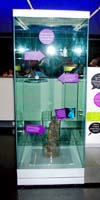
| ..Natural and artificial light in exhibtions or display cases has direct implications on displayed objects.
Many types of objects deteriorate with exposure to light and heat over time, exposure to light is usually more prevalent in museums than heat. The deterioration process requires energy, light and heat provides an energy source for this to take place. The source and level of light on an object needs to be addressed when designing its display.
Light in museums comes from three sources:
| Daylight |
Sun light through doors, windows and skylights. Direct and reflected. |
| Fluorescent |
Light is produced by passing electricity through a gas inside a glass tube, a coating on the inside of this tube fluoresces in the radiation emitted by the gas to produce visible light. |
| Tungsten incandescent |
Electricity is passed through a tungsten coil filament inside glass which heats up [to about 2700ºC] which then produces light. |
These each produce three spectrums of radiation:
| Ultraviolet radiation |
[ UV 300-400 nm] |
| Visible radiation |
[ light 400-760 nm] |
| Infrared radiation |
[ IR > 760 nm] |
Fabrics and textiles, works of art, and natural history specimens are all sensitive to damage by ultraviolet and visible light. Daylight contains the highest proportion of UV radiation, so requires UV filtration, followed by fluorescents, lastly tungsten incandescent.
Special mention must be of these lamps:
| 'Artificial daylight' |
Fluorescent and incandescent lamps emit as much UV as daylight, so should be avoided. |
| Halogen incandescent |
lamps operate at a higher temperature than standard incandescent lamps and so require an envelope of quartz instead of glass. This combination of higher temperature and absence of glass filter allows UV at a 300 nm wavelength to be emitted. This is particularly harmful frequency and must be eliminated. The addition of a plane glass filter on a halogen lamp fitting will eliminate this however and so must become the standard in museum halogen use. |
Glass provides a good general degree of UV filtration for windows, frame and display case glazing but is not sufficient in itself. Additional UV filtration plastic sheet or varnish products can provide localised UV protection for more vulnerable object. |